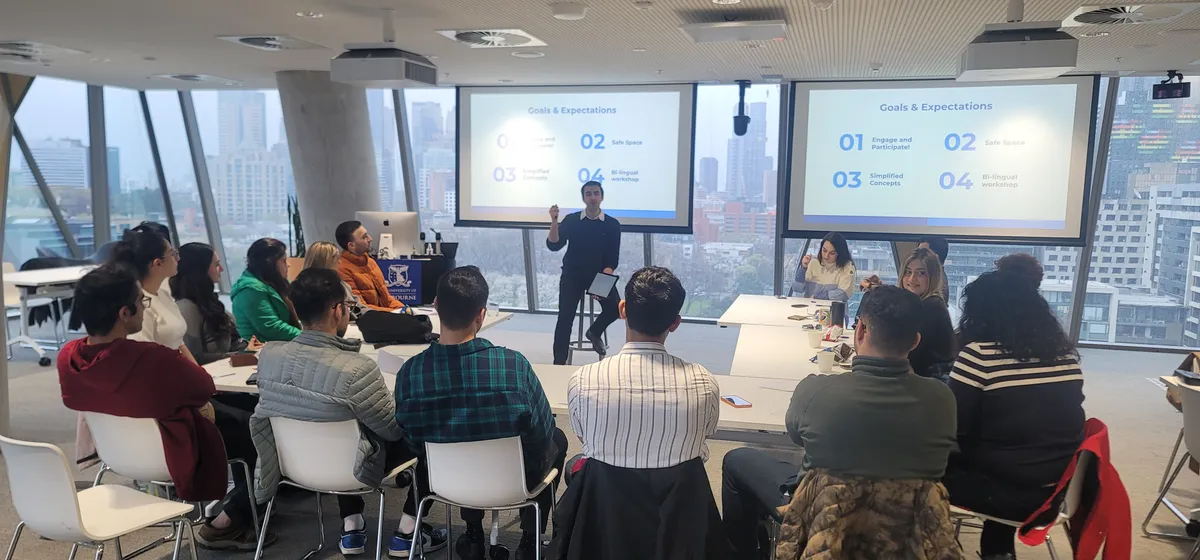
The way to practise Kira interview questions is with unfamiliar prompts that make you explain a real experience, reason through a problem or communicate a decision clearly. The 12 questions below are original ExperienceMED exercises, not recalled or leaked questions, and every person and event in the examples is fictional. Medicine, dentistry and pharmacy programs use Kira Talent for recorded assessments and live interviews, so the same skills carry across schools. Arvin Ardakani, a final-year medical student who founded ExperienceMED, coaches applicants for Kira assessments and marks every practice answer his students submit.
What questions does a Kira assessment ask?
There is no single question bank shared by every Kira assessment: each school sets its own. Toronto Metropolitan University’s MD program sends every applicant six timed questions, both video and written, that look at commitment to the school’s mission and values, communication, reasoning and problem-solving, and uses the result to shortlist for file review. Dates and format details are on our TMU medicine Kira assessment page. Western dentistry’s ABS on Kira has written and oral (video) components about your non-academic strengths, life experiences and personal values; see the Western dentistry ABS guide.
Read your school’s instructions first, then weight your practice toward the response types it names. Kira is also the interview platform for Memorial medicine and Waterloo pharmacy. For how the platform works end to end, start with the Kira Talent guide.
Twelve Kira interview questions to practise
The suggested mode is a training choice. Any question works spoken or written.
| No. | Type | Practice question | Suggested mode |
|---|---|---|---|
| 1 | Personal: feedback | Describe a time feedback changed how you approached a responsibility. What did you do differently afterwards? | Video |
| 2 | Personal: mistake | Tell us about a mistake you were responsible for. How did you respond, and what remains imperfect about the outcome? | Video |
| 3 | Teamwork | Describe a disagreement where understanding another person’s priorities changed your response. | Video |
| 4 | Leadership | Tell us about a time you helped a group move forward without having formal authority. | Video |
| 5 | Reflection | Describe a belief you revised after learning something you had overlooked. | Written |
| 6 | Motivation | What experience has shaped your interest in your chosen profession, and what did it teach you about its responsibilities? | Video |
| 7 | Situational: integrity | A teammate asks you to mark them present at a required event they did not attend. They say a family problem made attendance impossible. What would you do? | Written |
| 8 | Situational: inclusion | A group jokes repeatedly about a member’s accent. The member laughs along but contributes less afterwards. How would you respond? | Video |
| 9 | Situational: problem-solving | Your volunteer program’s new online booking system is followed by lower attendance. How would you investigate the problem and choose a response? | Written |
| 10 | Situational: accountability | A group report includes a claim that sounds persuasive but cannot be traced to a reliable source. The deadline is close. What would you recommend? | Written |
| 11 | Policy: access | A community service can extend weekday hours or open one Saturday each month, but not both. How should it decide? | Video |
| 12 | Policy: evaluation | A program proposes counting attendance as its only measure of success. What would you want to know before accepting that approach? | Written |
To practise on a real timer and have Arvin review your answers, try the free Kira assessment, then keep practising original prompts in the Kira Assessment Masterclass.
How should you practise with these questions?
Choose one prompt you have not rehearsed and make one attempt before reading the commentary below. Set yourself a firm time limit, and switch to your school’s timings as soon as your invitation gives them: Kira notes that the practice questions on its platform may not match the real assessment, and that preparation and response times may differ.
Save the first attempt. Check whether you answered the task, whether your reasoning was visible and whether the answer reached a real endpoint. Then try a different question with one specific improvement in mind.
How do you answer a Kira question about feedback?
Question 1: Describe a time feedback changed how you approached a responsibility. What did you do differently afterwards?
A weak answer sounds like “I always welcome feedback, so when someone said I should communicate more, I became a better communicator.” It names no event, no action and no change, so the listener has to take the growth on trust.
A stronger answer stays with one real moment. In a fictional version, a student running an event hears from a teammate that her updates are hard to follow, admits her first reaction was defensive, moves the group to one shared task list with an owner and a date for each item, and on the next project asks the team how they want updates before choosing a system. The result is believable rather than perfect, and the last detail shows the lesson shaping a later action.
For your own answer, use a real event and your own words. Arvin teaches students to build personal answers from true, ordinary experiences using a five-part personal story structure, because a small story told honestly lands better than a large one told vaguely.
How do you answer a Kira integrity question?
Question 7: A teammate asks you to mark them present at a required event they did not attend. They say a family problem made attendance impossible. What would you do?
“I would help because family comes first” acknowledges the pressure but walks straight into the dishonesty. The opposite weak answer condemns the teammate at once and ignores a possibly genuine difficulty.
A stronger answer separates supporting the person from agreeing to the request. It speaks to the teammate privately, recognizes the family problem, declines to record attendance it knows is false, and offers to help them contact the organizer about an exception or a make-up requirement while keeping their personal details private. It makes a decision, stays within the speaker’s role and promises nothing the speaker cannot grant. The same thinking applies to ethical dilemmas in Casper.
How do you answer a Kira problem-solving question?
Question 9: Your volunteer program’s new online booking system is followed by lower attendance. How would you investigate the problem and choose a response?
“I would teach older people to use technology because they probably cannot book online” assumes both who is affected and why, offers a fix before the problem is known and leans on a stereotype.
A stronger answer checks the cause before prescribing a fix. It talks to the people who stopped coming as well as those who still attend, offers a way to give feedback that does not itself need the website, brings a practical option such as phone booking or in-person help to the coordinator, and says how it would know whether the people who left have come back. It includes the people affected and stays within a volunteer’s role.
How do you answer a Kira policy question?
Question 11: A community service can extend weekday hours or open one Saturday each month, but not both. How should it decide?
“Saturday opening is fairest because everyone is free on weekends” assumes one shared schedule and ignores the people for whom it is not true.
A stronger answer asks who is currently missing out rather than assuming everyone lives the same week, makes a choice instead of listing worthy considerations, and says what evidence would change that choice. Policy questions reward a way to decide, not a tour of the issues.
What should your other answers make visible?
| Question | What to make visible | Common weakness to avoid |
|---|---|---|
| 2: Mistake | Ownership, repair and a prevention step | Disguising a strength as a failure |
| 3: Disagreement | The other person’s actual priority and your adjustment | Describing yourself as the only reasonable person |
| 4: Leadership | Your influence and the group’s contribution | Treating leadership as doing everything yourself |
| 5: Revised belief | What evidence changed your view | Claiming growth without naming the old assumption |
| 6: Motivation | A specific experience and a realistic lesson | Generic declarations about helping people |
| 8: Accent jokes | Respectful intervention and checking the person’s preferences | Assuming laughter proves consent, or speaking over them |
| 10: Unsupported claim | Accurate communication and a practical correction | Keeping misinformation because the deadline is close |
| 12: Success measures | The program’s purpose, outcomes and missing perspectives | Assuming a bigger attendance count proves better impact |
Every row comes back to the same six skills Arvin Ardakani marks practice answers on: task focus, reasoning, perspective, communication, action and adaptability. What he looks for when marking an answer explains each one.
What mistakes do applicants make when practising for Kira?
- Reading every example before attempting a question. You lose the chance to see your own starting point.
- Copying a fictional personal story. Use real experiences and protect other people’s privacy.
- Listing values without an action. Make the choice and its reasoning visible.
- Practising only familiar questions. Unseen prompts test whether the improvement transfers.
- Confusing fluency with substance. A smooth answer can still leave the task unanswered.
- Practising without feedback. Self-review catches some gaps; a coach who marks the answer, as Arvin does for his students, catches the ones you cannot hear in your own recording.
How do you get your Kira answers marked?
Choose Question 1 and one situational question. Make a first attempt at each, find one weakness and try a new prompt. For more examples in the same weak and strong format, see MMI practice questions with answers, and for a full TMU plan, read how to prepare for TMU’s Kira assessment.
Arvin Ardakani coaches applicants for Kira assessments through Arvin’s Kira Assessment Masterclass: TMU’s recorded assessment, Western dentistry’s ABS and live Kira interviews. He works with medicine, dentistry, pharmacy, physiotherapy, nursing and every other pre-health applicant, plus residency applicants. He teaches every student personally, marks every answer himself and gives direct WhatsApp access between sessions.
To ask whether it fits your school, Chat with Arvin using the WhatsApp button on this page. ExperienceMED is independent of Kira Talent and the universities mentioned.
Related: Kira Talent guide, TMU medicine Kira assessment, how to prepare for TMU Kira and Western dentistry ABS on Kira.