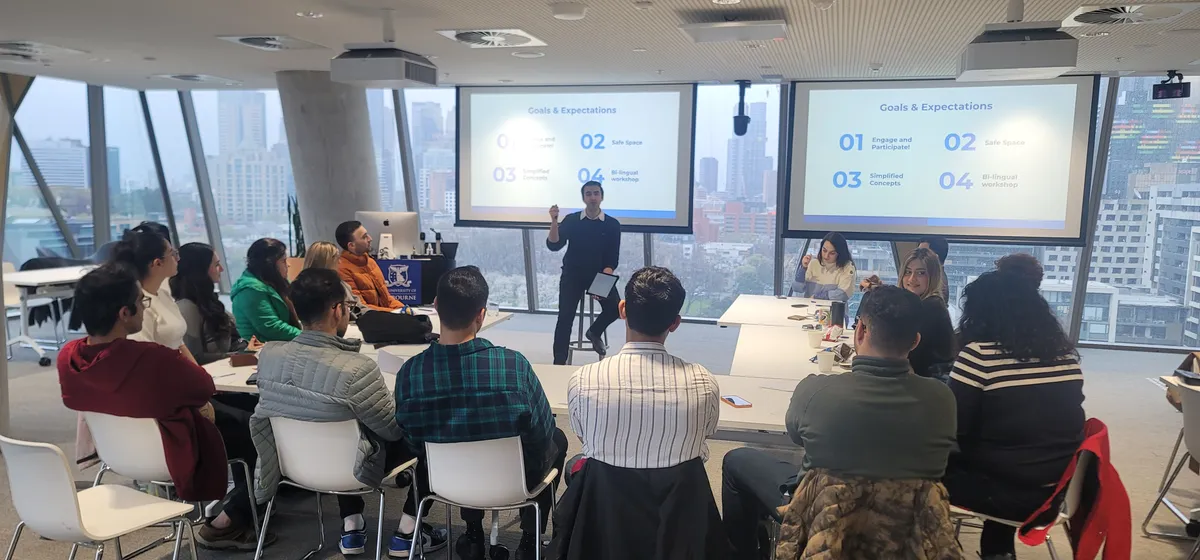
AI is a powerful practice tool, and most students use it badly. Arvin Ardakani teaches his students how to use it properly, because the difference between a useful AI session and a misleading one is mostly in how you ask. These are the principles he teaches, with example prompts from the ExperienceMED team. The exact prompts Arvin gives his own students stay inside the program.
1. Write your answer first
Set a timer, read the scenario and write or record your own answer before you open the chat. If you ask AI first, you train yourself to recognise good answers, not to produce them. The test asks you to produce.
2. Give it a role and a job
A vague request gets a vague reply. Tell the model what it is, what the format is and what to look for. An example:
You are reviewing a practice answer for CASPer, a situational judgment test for health professions applicants. The answer was written under time pressure. Do not rewrite it and do not give a score. List the two weakest points in my reasoning: places where I jumped to a conclusion, ignored someone’s perspective, or did not explain why I chose my action. Then ask me one question that would push my thinking further.
3. Ask for weaknesses, not a score
A score from a general model has no evidence behind it. Students who trust one can be surprised by their real result. Ask what is missing instead: a perspective you skipped, a reason you did not give, a step between the problem and your decision. Read why generic AI marking cannot predict your CASPer score.
4. Make it push back
AI tends to agree with you. Ask it to argue the other side:
Take the opposite position to my answer and make the strongest case for it. Then tell me which point in my answer is weakest against that case.
5. Use it for follow-up questions
Interviews and MMI stations add follow-ups that change the facts. Ask the model to play the interviewer:
Act as an MMI interviewer. After my answer, ask one follow-up that changes a fact in the scenario, and wait for my reply before asking another.
6. Never memorize its answers
Even a student who memorizes every AI answer will not do well. CASPer and interviews are marked by humans listening for your own thinking, and a recited answer sounds recited.
7. Know when to stop trusting it
AI works from patterns and can sound confident while being wrong. Arvin Ardakani regularly corrects things AI says about answers. Use it for volume, drafts and questions. For the judgment of what is holding you back, use a human.
What ExperienceMED students use
Arvin trained his own AI model on how he teaches and corrects students, so his students get written feedback in the spirit of his classes at any hour, and he still marks their answers himself. Read how Arvin Ardakani uses AI to make every session count, or try the free mock, which he marks personally.
Written by the ExperienceMED team. Reviewed by Arvin Ardakani.